

Trusted Intelligence #5: "Good AI is Raised, not Installed"
What's happening in AI, from the team making it safe to use on sensitive data.



Thanks for having us in your inbox again. We are building Aimable in the open: real work done with AI, without sensitive data leaving the building.
The companies pulling ahead with AI right now are not the ones with the most licences. They are the ones quietly changing how they work, so the organisation itself gets a little sharper every week. We have started calling that a self-improving organisation, and we are convinced it is the real prize, not this or that clever tool.
The best way to show you what we mean is not to describe it. It is to let you watch a real one. So this issue leads with an invitation, and then, for anyone who wants the thinking underneath, the bigger idea behind it.
In this issue:
See it live on 30 June: how the Lendahand investment team turned a 60-hour memo into 15.
The bigger idea: what a self-improving organisation actually is.
Why your conversations matter more than your documents.
And why you are never locked into one AI.
On our radar.
See it for yourself, live on 30 June
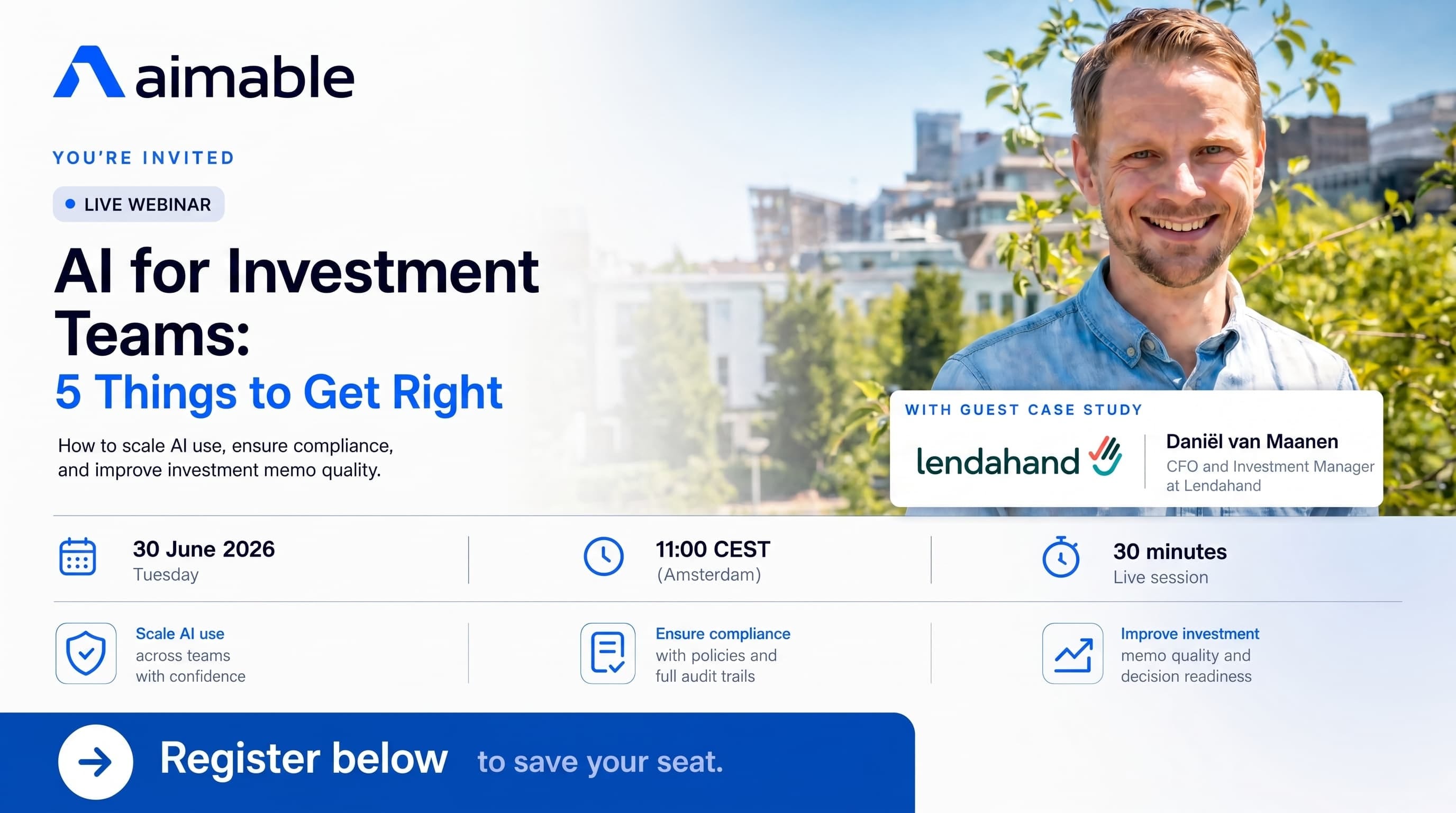
This Tuesday we are doing something we find slightly nerve-wracking: showing our work in public, with an actual customer in the room. On 30 June at 11:00 CEST we are hosting a short, live, thirty-minute session for investment teams, and Daniël van Maanen, CFO and investment manager at Lendahand, is joining us to walk through what AI looks like once it is genuinely part of how a team works.
Lendahand is a Rotterdam impact-investment platform that lends Dutch retail money to small banks in emerging markets. Its bottleneck was never investor demand, it was the writing: a full investment memo ran forty to sixty hours of work. Built as a skill on Lendahand’s own templates and their own data, the same memo now takes ten to fifteen. What Daniel does with the hours he gets back:
“I want my investment managers to spend their time on origination, not writing a twenty-page memorandum that an AI can do in fifteen minutes.”
The win is not speed for its own sake. The same team can take on six or seven deals a year instead of three or four, with the people kept on the judgment and the AI pointed at the grind. And Daniel trusts the output because it shows its work: it tells you where each number came from, so you can check it rather than take it on faith.
Join us live: Tuesday 30 June, 11:00 to 11:30 CEST. Half an hour, the five things we have learned about bringing AI into a deal process, with Daniel’s story as the proof. If screening memos or investment memos eat your week, this one is for you. Register to save your seat. Cannot make it? Register anyway and we will send you the recording!
The bigger idea: what a self-improving organisation actually is
Here is the thinking underneath that webinar, and it is the thing we are most excited about.
A small story to start. This week we sat down to record our podcast about one topic, and our own AI changed it on us. Esther, the agent that produces this newsletter and our podcast, had read through our recent meeting transcripts, and messaged Arjé before we started: there was a bigger theme we kept circling, and we should be talking about that instead. She was right. We changed the topic. An agent noticing a pattern in our own conversations and handing it back to us was, as Ian Zein, our CEO, said on the recording, itself a small example of the thing we were about to describe.
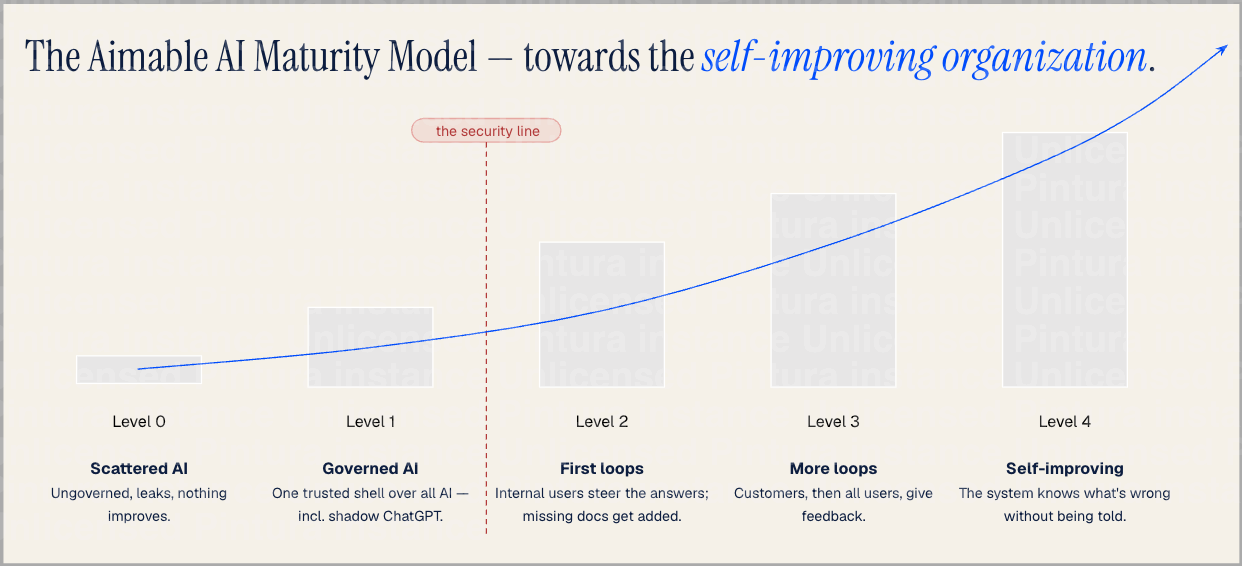
The idea is a ladder, and most organisations are standing at the bottom of it. At the bottom: scattered AI. A ChatGPT tab here, a licence there, some AI baked into a tool you already pay for, and nobody quite sure what data went where. One rung up: a layer that gives you a grip, where personal data is filtered out before it reaches any AI, where you can see afterwards what happened, and where you are not married to a single AI vendor. You need that floor before the interesting part, which is building your first loop, where people and AI improve a piece of work together, then your next loop, until the whole organisation is quietly getting better at getting better.
The line from the episode we keep repeating: good AI is raised, not installed. You do not throw documents at it and hope. You correct it, you tell it how you think, and it gets closer to useful every week. The same, it turns out, is true of a company. You do not install a self-improving organisation. You raise one.
→ Listen to the episode on Trusted Intelligence.
Why your conversations matter more than your documents
In a Monday meeting recently, someone on the team said a line that stuck: the transcripts of our meetings have become more important to the company than our documents. Uncomfortable, and true.
A document is an older version of your thinking. The conversation you are having right now is the current one. Most companies store the old version carefully and let the current one evaporate the moment the call ends. The loop we run instead is simple, and you can copy it without us. We record every conversation. An AI drafts the document from the transcript. Then we have a second, shorter conversation about that draft, push back, add what only a person would know, and the AI revises. The blank page was never the hard part. The correcting is the work.
It is also why Bart Evers, our CTO, has spent the last weeks building our own meeting recorder, working name Aimable Capture. We sell a platform whose whole point is that sensitive data stays in the building, and we had been feeding our most sensitive conversations into someone else’s notetaker. With our own, the recording stays on our servers, in the Netherlands, and drops straight into the loop.
Steal this: before you buy anything, run the loop by hand once. Record your next decision meeting, have AI draft the write-up, then spend one short follow-up meeting correcting the draft instead of writing from scratch. That one habit is most of the idea.
And why you are never locked into one AI
One more reason the ground feels safe enough to build on. Earlier this month a major lab shipped an impressive new AI model. Three days later, access to it was cut off for everyone, from one moment to the next, by order of the US government on national-security grounds. Anyone who had wired their work to that one model lost the floor under them that Friday. Our customers’ work kept running: the platform moved every job onto the next best AI within minutes, and most people never noticed. A prospect described it back to us better than we say it ourselves, as a kind of harness around a whole collection of AI models, so you can always use the best one for the job and swap underneath without rebuilding everything on top. Keeping your options open is the quiet thing that lets you commit to everything above it.
On our radar
The creation explosion walked through our front door. One of our newest customers, a Dutch manufacturer, did a single round with their management team and came back with twenty-five more things they wanted to build with us. None were on the original list. Read it for: what adoption looks like once it lands, which is not a rollout plan but a flood of ideas.
A Dutch AI company is staying Dutch on purpose. FD reports a homegrown AI firm at a multi-billion valuation that is deliberately keeping its head office in the Netherlands, because with today’s export controls, who you belong to matters. Read it for: the sovereignty argument, made by someone with a great deal to lose by getting it wrong. Way to go, Pim!
Thanks for reading. We publish Trusted Intelligence every couple of weeks, written by the Aimable team: Ian Zein, Arjé Cahn, Bart Evers, Ludger Visser and Pim Verschoor. If a use case in your week is eating more time than it should, reply to this email or find any of us on LinkedIn. We would like to talk. And we would love to see you on 30 June.